Review of the First Quarter of the 21st Century: World of Change
Written by Don Ford on January 5, 2026
World of Change
The first quarter of the 21st century, spanning from 2000 to 2025, has been a period marked by rapid change fueling armed conflict and further integration of the entire globe. The world entered this century with much hope for the future. We were largely at peace, the long Cold War ended and the USA standing alone as the world’s dominant superpower, although China expressed ambitions to surpass us by 2100. We had high hopes that the U.S. would use its immense power and peace dividend for global good. The newly invented internet promised to connect people in ways that had never been imagined before and unleash an era of immense productivity and creativity. In short, the world heralded the dawn of the 21st century with high hopes for peace and prosperity.
The Historical Record
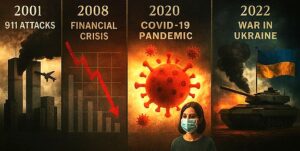
Alas, that was not to be. In the second year of this new century, an act of terrorism occurred on September 11, 2001, so heinous it shocked the world and permanently altered the way people travel. The U.S. response under President Bush was to launch an invasion of Afghanistan, not because it was responsible for the attack, but because it harbored the organization who had taken credit – Al-Qaeda. After conquering and subjugating that nation, Bush-Cheney, both oil men, turned our armed forces against oil-rich Iraq and lied us into a second war. What started as a military response to a small band of stateless terrorists eventually morphed into a decades-long holy crusade against Islam and those who preached it. Even today, 24 years later, Islamophobia is still a potent force in American politics, used to smear anyone whose origin is a Muslim nation.
Bush’s second term brought the world the worst global recession since the Great Depression. The financial crisis shook markets and livelihoods worldwide, prompting a controversial bailout of the global financiers who had created the crisis, because they were too big to fail. Governments reacted by creating new laws and increased oversight of financial markets who had proven incapable of policing themselves.
The financial crisis of 2008 also brought us what will undoubtedly be remembered centuries from now – the first African-American President of the United States, Barack Obama. His presidency signaled a new political era. He managed to expand health care insurance to 40 million uninsured Americans, wound down the Iraq War, avenged 911 survivors by taking out Osama bin Laden and positioned the United States as a global leader in the new fight against climate change. Historians generally consider him to be the best president of this century so far.
Obama’s presidency also created a bitter backlash among White Republicans, who refused to accept a black man as their President. Starting with the Tea Party and eventually leading to the MAGA movement and the election of Donald Trump, conservative whites vowed to seize power back from what they considered to be an illegitimate president and the Democratic party who brought Obama to power.
I would argue that everything that has happened in American politics since Obama’s election has been a backlash against it. Trump started his political movement by questioning Obama’s birth. He brought together an unlikely coalition of white racists, neo-nazis, disaffected working class whites, white Christian nationalists, libertarians and traditional Republican Wall Street investors to shock the world and win the 2016 election over Hillary Clinton, who would have been our first female president.
Instead, we got four chaotic years of MAGA rule, culminating in the worst pandemic to hit the world since the Influenza epidemic of 1918. Although COVID-19 originated in China, and dealt a serious setback to that nation’s global ambitions, the Trump administration’s bungled response and our inadequate public health system led to over one million Americans dying, including estimates that up to half of those deaths could have been prevented except for vaccination disinformation coming from the President and his administration and our overwhelmed public health system that could not respond to the crisis quickly enough.
Weary of Trump’s chaos, Americans turned to Obama’s Vice-President, Joe Biden, to lead us in 2020. Instead of accepting the will of the people, Trump refused to concede defeat and instead went on a campaign of deceit and deception to try to overturn the election. This culminated in Trump orchestrating the worst attack on our Capital since the British invasion during the War of 1812. Ultimately, democracy held and Trump left office to his successor, but he left a bitterly divided nation in his wake.
Joe Biden had one of the most successful presidencies of modern times, passing a massive bill to rebuild America’s aging infrastructure, finally ending the war in Afghanistan and leading the nation out of the COVID pandemic and its lockdowns that had tanked the economy. As the economy roared back to life, inflation took off and haunted the latter half of his presidency. In his fourth year, after already gaining his party’s nomination for a second term, his advanced age suddenly became a huge issue that prompted the Democratic Party to do something that we hadn’t seen since the 19th century. They replaced Biden with his Vice-President Kamala Harris just months before she faced Trump in his third run for the presidency. Once again, Trump shocked the world by winning re-election to non-consecutive terms, the first president to do so since the late 19th century. Trump 2.0 has proven to be more aggressive, more vindictive and more lawless than anything we saw in his first term. His mass deportation campaign has shredded human rights and left a stain on our nation. His tariffs are wrecking the world economy and causing massive swings in financial markets.
Major Trends
Besides our contested politics, the other big story of this first quarter century is technology. After the invention of the internet in the mid-nineties, computer technology advanced at an unprecedented pace, with the rise of smartphones, social media, and artificial intelligence revolutionizing communication, business, and daily life. The smartphone, introduced by Apple in 2007, was arguably the greatest technological breakthrough so far this century. Combining two of humanity’s most important inventions – the phone and the personal computer – into one device that fit in the palm of your hand was pure genius. Today, 3.8 billion people, nearly half of planet Earth, have a smartphone. For many, work and life itself could not take place without it.
Generative artificial intelligence, which has developed in the past few years through large language models, promises to further revolutionize life in the next quarter century. By 2050, we can expect artificial intelligence to blur the line between human and machine. How that happens is going to be the work of both technologists and governments representing the will of their citizens. AI could potentially make a handful of people insanely rich and leave the rest of the world destitute, or it could become the great equalizer that enables anyone with an idea and some fortitude to pursue their passion through AI tools readily available to all. Finally, AI could also usher in the Orwellian nightmare of a surveillance society devoid of any personal freedom.
Another central global concern is the threat to life on Earth represented by climate change. Although our planet has been warming steadily for the past 200 years, due primarily to the global burning of fossil fuels, startling evidence emerged in the early 2000s that warming was accelerating at such an alarming clip, scientists predicted that we could see catastrophic effects in this century, including average temperatures 1.5C above 2000 levels that would cause glaciers to melt and sea level to rise by at least 1M (3 feet), flooding many densely populated coastal cities. Alarmed global leaders came together through the United Nations to combat global warming with efforts like the Paris Agreement in 2015. However, the powerful fossil fuel industry has mounted a massively funded counterattack, claiming global warming is just natural weather variation or outright declaring it a liberal hoax. As the politicians squabbled, the Earth lost valuable time that humanity can ill afford. Scientists say it’s still not too late to stop the worst effects, but most quietly admit that we are in for a rapid increase in climate disasters in the next quarter century. Storms will be more powerful and frequent with the climate damage we’ve already done. Droughts and heatwaves will intensify as the earth’s climates shift toward the Equator.
A third theme of this quarter century has been social and cultural change. Throughout this period, grass roots movements of disaffected people advocating for social justice, equality, democracy, inclusion and environmental sustainability gained momentum across the globe, shaping the course of the century. People Power such as the Arab Spring toppled autocratic governments in the Middle East, and local movements also brought democracy to more nations in Latin America, Asia and Eastern Europe. Civil rights expanded to include not only race, but gender, nationality, religion, culture, language and age. The Black Lives Matter movement refocused American attention on the glaring racial bigotry still plaguing our nation. Throughout this century, humans have begun to see themselves as part of a global village, the internet and air travel bringing us closer together than at any time in human history. These movements reflect broader demands for social inclusion and equity and a universal standard of human rights for all.
Of course, as with any social change, the backlash that followed has been fierce and ugly. Immigrants have become the scapegoats blamed for all the problems and disruptions caused by the easy movement of people across the globe. Nationalism has reared its ugly presence once again, with nations like Russia, China and America trying to carve out spheres of influence in an increasingly divided and dangerous world. We have avoided a third world war for 80 years, but whether we continue this streak will depend on how global leaders choose to act in the next quarter century.
Whither the World?
And so, here we are, already a quarter century in, and what have we managed to accomplish? We’ve undeniably seen huge advances in science and technology and the way humans both interact with and depend on computing technology to live our lives. We’ve also seen a world drawn into new regional conflicts that threaten to explode into world wars of the future. In the US, our politics have been polarized, with a country nearly evenly divided about how we should govern ourselves. Thus, we have seen our presidency traded back and forth between our two political parties, neither able to sustain a government coalition for more than eight years at a time. It feels like we’re taking one step forward and then one step back, enormous effort and treasure spent on getting us nowhere.
Hanging over all of our accomplishments and conflicts is the very real possibility that we may be polluting our planet to the point of human extinction, thus bringing to an end a 600,000-year run of dominance. I’m not exaggerating to predict that what we do by 2050 will have a lot to say about our long-term survival as a species. I may not be here to see it, but I can only hope that reason prevails over emotion, and we find a way to live together in peace, sharing this modern world we have created and preserving it for future generations.