Plutocracy and Corruption At Work
History rarely unfolds politely. Some years may arrive with a whisper, incremental changes that only become important in hindsight. Others arrive like a siren, blaring so loudly that even those who try to ignore it feel the vibration. For Americans, 2025 was unmistakably loud and unruly.
Destroying Government in Order to “Save” It
The return of Donald Trump to the presidency— “Trump 2.0” —dominated political, social, and economic life in the United States. It was not merely a continuation of his first term, but an escalation: more aggressive, more vindictive, and more openly dismissive of norms that had once constrained presidential power. What unfolded over the course of the year left the country more polarized, institutions more fragile, and public trust more depleted than at any time in recent memory.
Trump 2.0 started with Elon Musk and his DOGE minions ransacking and destroying vital government agencies as he reigned over a temporary co-presidency. Under the banner of efficiency, Musk’s band of merry marauders descended on federal agencies, pushing mass layoffs, dismantling long-standing programs, and disrupting operations that provided essential services. Opponents described it as ransacking—an ideologically driven assault to destroy the state itself. What was lost in the noise was not just institutional knowledge, but the principle that public agencies exist to serve citizens, not private interests or political vendettas. Musk and his DOGE boys reportedly stole millions of government documents and fed them into his AI engine, including the Library of Congress and the personal tax information of millions of Americans.
Weaponizing Immigration Enforcement
If there was one policy area where Trump 2.0 wasted no time asserting itself, it was immigration. His promise to begin the largest mass deportation in U.S. history quickly unfolded with militarized enforcement actions disproportionately targeting Democratic-led cities. Trump nationalized the California National Guard and even sent the Marines to the streets of my hometown Los Angeles, putting the downtown area under martial law.
Anyone who looked Latino or spoke Spanish was subject to immediate arrest and imprisonment, quickly followed by deportation to anywhere that would take them. Although Trump’s Homeland Security chief kept telling us the government was concentrating on the “worst of the worst” criminal immigrants, it quickly emerged that they were fulfilling a macabre quota to arrest and deport millions of undocumented immigrants devoid of any crime except being in the country without permission. In my own neighborhood, a 10 year old boy and his immigrant father were snatched in front of his elementary school and quickly deported to Guatemala, despite the fact the boy was a U.S. citizen. Photos of toddlers being detained and kept in a kiddie jail away from their parents sent shockwaves through a nation that has grown weary and numb from the constant assault on basic human rights.
The social consequences were immediate and severe. Families went into hiding. School attendance dropped in immigrant neighborhoods. Employers lost workers overnight. Trust between local governments and federal authorities collapsed. For millions, daily life became defined by anxiety—an ever-present fear that any interaction with the authorities could result in detention or deportation. There’s a name for such a society: police state.
Erosion of the Rule of Law
As immigration enforcement spread across cities throughout the U.S., so too did concerns about the administration’s approach to the law more broadly. The Department of Justice and the Department of Defense, led by officials widely viewed as unqualified sycophants to the President, became flashpoints for controversy. Taking their cue, Trump’s loyalists running these Departments decided that they didn’t need to follow the law or existing rules governing their conduct. They flagrantly broke the law by bringing vindictive prosecutions against Trump’s political enemies at his direction and starting an undeclared war with Venezuela, killing shipwrecked survivors whose boat had already been illegally targeted.
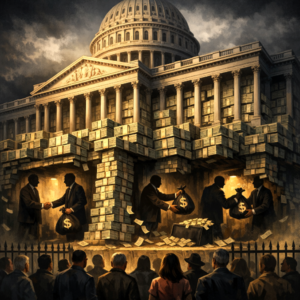
As attention focused on the circus show at the White House, the Trump family enriched itself at a level never seen in our history. The Trump family is estimated to have made several hundred million dollars in 2025 on its cryptocurrency business alone, most of it through sweetheart deals afforded the sitting President of the United States. Saudi Arabia’s MBS has funneled 2 billion dollars to Trump’s son-in-law’s business. The government of Qatar gifted Trump a $400 million dollar plane, despite our constitution’s prohibition against the president accepting foreign gifts. Credible rumors suggest that Russia’s Putin and his criminal cronies, including billionaire Kirill Dmitriev, have laundered money through Trump’s hotel, casino and golf businesses. No wonder Trump loves those guys!
In a country founded on rebellion against monarchy and taxation without representation, the idea that the presidency could be leveraged so openly for personal gain struck many as a betrayal of the republic itself. Critics also pointed to the obsequious behavior of the Republican-controlled Congress and Supreme Court, who both bent over backwards to give Trump unlimited authority and immunity for any of his lawless actions. By year’s end, the pattern was unmistakable: a governing philosophy that treated legal constraints as optional and accountability as an obstacle rather than a safeguard.
Economic Winners, Economic Losers
Economically, 2025 was a year of stark contrasts. Markets initially responded positively to deregulation and tax-friendly signals from the administration. Certain sectors—energy, defense, and AI technology—saw rapid gains. Wealth concentrated even further at the top. For working- and middle-class Americans, however, the picture was far bleaker. The dismantling of federal agencies disrupted services ranging from disaster response to public health. Cuts to health care and food support left the poor sicker and hungrier than ever. Immigration crackdowns contributed to labor shortages in agriculture, construction, and service industries, driving up prices while reducing economic output. Most Americans are surviving on personal debt, which reached a record $18 trillion this year. For the top 1%, their wealth grew to $50 trillion, 30% of the U.S. total. Elon Musk will earn $1 trillion all by himself.
Meanwhile, the administration’s focus on spectacle and loyalty left little room for serious engagement with long-term challenges such as economic stagflation, housing affordability, healthcare costs, or infrastructure investment. Other pressing issues, such as climate change, were completely abandoned. Economic policy became reactive rather than strategic, driven by political optics rather than public need. The result was a K-shaped economy in which the wealthy saw their fortunes spike while the poor and middle class suffered declines in purchasing power and diminished opportunities to get ahead.
Trump’s main economic policy was the tariff, a tax on imported goods. While selective tariffs have always been part of government policy to regulate foreign trade, Trump decided to go all in with across-the-board massive tariffs on every country in the world. This sent shock waves through the global economy and has been the main source of inflation this past year, since importers add the tariff to the prices they charge.
It’s as if Trump decided to declare war on the global economy, including our closest ally and neighbor, Canada. For what purpose remains unclear. He has claimed he’s bringing jobs back to America, but few have returned so far and they have been offset by the loss of jobs in import-sensitive areas. He has also claimed that tariffs will replace income taxes as a source of government funding. However, Trump’s tariffs only brought in about $200 billion last year, barely enough to cover the Federal government’s immigration raids and deportations. Tariffs are among the most regressive of taxes since their cost falls heaviest on the working class. Perhaps that’s really why Trump and the plutocrats love them.
To continue the lawless theme that dominated 2025, our Constitution specifically assigns tariff policy to Congress, not the President. He is acting under his emergency powers, declaring a fictitious national import emergency to justify acting alone. Once again, Republicans running the Congress and the Supreme Court have both signaled that they are perfectly fine with Trump turning his office into the dictatorship he promised would begin “on day one.” It will be interesting to see how they react when a Democrat once again occupies the White House and declares an actual emergency to combat climate change or stop the scourge of mass killings plaguing our nation.
Social Fracture and Democratic Fatigue
At the end of 2025, the social fabric of the nation is visibly strained. It feels like a new civil war has broken out. This year, trust in institutions, already fragile, eroded further. “No Kings” protests became routine, drawing the largest crowds since the 1960s. The language of politics grew ever more dehumanizing and hateful, our Dear Leader pointing the way to his public sewer – Truth Social. Gun violence has exploded into over 400 mass shootings this year, more than one per day.
Most dangerously, a sense of democratic fatigue took hold. Many Americans began to question whether the rule of law still mattered, whether elections still were legitimate, and whether accountability was only for the “little people.” Millions decided to tune out politics altogether. Trump 2.0’s most lasting legacy so far is not any single policy or scandal, since we have seen so many, but the normalization of the idea that power exists to be exploited for personal advantage, not stewarded in the interests of the people.
A Year That Will Not Be Forgotten
Years like 2025 do not pass quietly into history. They linger, debated and dissected for generations. Supporters will argue that Trump delivered necessary disruption to the “deep state,” closed our borders and projected American strength. Critics see a cautionary tale of what happens when democratic norms and the rule of law are treated as inconveniences rather than firm commitments and key institutions bend the knee to authoritarianism.
What cannot be denied is that 2025 reshaped the American political landscape. It exposed the vulnerabilities of institutions long assumed to be self-sustaining. It revealed how easily fear and spectacle can be used to obscure corruption and concentrate power. And it forced a reckoning with a question the nation has faced before, but never fully answered: What does our democracy require of those who hold power and of the citizens who elect them to office? As we look ahead to the second quarter of the 21st century now upon us, the answer to that question will determine whether 2025 is the moment the country crossed a line into plutocracy that would have our founders rolling in their graves or the impetus for an awakening that rejects the ruling class and renews our historical commitment to liberty and justice for all. I can assure you that I will be watching closely.
Personal News
For those who have read this far, 2025 provided its own set of personal challenges for me. I’m grateful that I’m still able to work at my age and continued to enjoy my two remaining active clients – Association for Talent Development (ATD) and ANSI National Accreditation Board (ANAB). I’ve been facilitating Train the Trainer certificate programs for the former since 2000, so they have now become my longest employer. For ANAB, I accredit certificate programs to ISO standards in a variety of fields, most connected to safety or security, and celebrated my 16th year with them.
In my spare time, I took on the leadership of the Redondo Beach Chamber of Commerce in July, taking over as Chairman of the Board for the year during a time when we were transitioning to a new CEO. I gained new insights and appreciation for the wonderful city of Redondo Beach, a seaside community dating to the late 19th century with a rich history and promising future. I also continued to serve as a Board member on my local South Bay Workforce Investment Board (WIB), which oversees federal and state workforce development funding for our area. I continued to work with local schools to promote youth development, including the Redondo Beach Chamber of Commerce’s Future Business Leaders college scholarship program, something I helped found 16 years ago which is still growing in response to an uptick in interest in entrepreneurship as a career.
Despite all that involvement, I also found time to play lots of golf with my two sons and to tutor my granddaughter through her senior year of high school. My life partner and I still managed to travel locally and enjoy many of the finer restaurants and entertainment that the Los Angeles area provides its residents. I look forward to resuming international travel in 2026, including a trip to Indonesia already booked for February. I am truly blessed to have family nearby and rewarding work to keep me going.
Priceless Moments
As in years past, 2025 provided a host of memories that will not be soon forgotten. Here’s a sample of some that stood out for me:
To Pope Leo XIV (aka Robert Prevost): Your surprise selection as the first American Pope in May excited American Catholics and brought a bit of Chicago culture to the world. We found out some very humanizing things about the man who is supposed to be closer to God than anyone, including the fact that he loves his hometown Chicago White Sox and deep-dish pizza. The more serious work ahead is to show how the Church will remain relevant in a world full of evil doing.
To Labubu Dolls: The celebrity accessory of choice in 2025 wasn’t a luxury handbag, but a monster plush toy from Hong Kong artist Kasing Lung. Labubus became so popular that they earned their own float in Macy’s Thanksgiving Day parade. Look for film, TV and music deals in 2026 as Hollywood cashes in on the latest cultural phenomenon that no one could have predicted.
To the Security Team at the Louvre: After the world-famous French museum suffered a spectacular theft of priceless crown jewels from the Napoleonic era, your security protocols came under intense scrutiny. We learned that the password for the museum’s video surveillance system was—wait for it—”Louvre.” Easy to remember, sure, but also easy for the thieves to hack. Maybe try a little stronger password next time?
To the 6-7 Meme: If you have any tweens in your life, you’ve probably seen them bust out in uproarious laughter at the mention of two numbers that are otherwise meaningless – 6 7. What’s the inside joke? No one seems to know for sure, including my own 13 year old granddaughter. All she could tell me is that it came from a rap song by Skrilla and somehow also involves NBA star LaMello Ball, who happens to be 6 feet 7 inches. Adults are still scratching their heads trying to figure out what the kids are all laughing about, which is probably the whole point of this Gen Alpha meme.
To the Memory of Charlie Kirk, MAGA Martyr: Your life was tragically cut short by an assassin’s bullet and in death, you continued to create controversy. While the MAGA right proclaimed you a martyr to their cause, MAGA politicians rushed to exploit your death and tried to force Jimmy Kimmel off the air for having the audacity to remark about Kirk, “His death has amplified our anger, our differences.” For that offense, right-wing TV station owners refused to air Kimmel’s late night show, causing ABC to temporarily suspend him. As MAGA exalts Saint Charlie, let us ponder some of his most poignant words of wisdom to guide mere mortals: “We made a huge mistake when we passed the Civil Rights Act in the 1960s.” “I think it’s worth to have a cost of, unfortunately, some gun deaths every single year so that we can have the Second Amendment to protect our other God-given rights.” “Birth control really screws up female brains.” “There’s a direct connection to inflation and the trans issue.” I hereby withdraw my application for sainthood.
To the Legacy of Jeffrey Epstein: Just as we wondered where the moral bottom of our nation might be, we have finally settled on child sex trafficking as the one thing we can unanimously condemn and label unadulterated evil. The only problem is we can’t seem to find the courage to hold all those responsible accountable for their crimes. Trump and his sycophants continue to fight the full disclosure of the voluminous evidence that exists about Epstein’s crimes and those who participated, facilitated and financed the exploitation of over 1,000 victims over a 20 year period. We already know that Britain’s Prince Andrew was part of the crime spree and there were hundreds of other powerful men who participated. Still to come is whether Epstein’s best friend, who freely admitted he likes to grab women by their pussy and has been convicted of doing so, was also grabbing 14 year old’s pussy and what he termed “pert nipples.” 2026 should fill the tabloids with ample salacious material to last the rest of the decade.



Jeanne Hartley On December 26, 2025 at 10:01 pm
Another thoughtful and informative piece, and unfortunately it could have been much longer with the insanity we have been living through. And I’m so pressed with what you are doing professionally Don. Still making an impact. Happy New Year dear friend