What Every Manager Should Know About Human Performance Improvement (HPI)
Written by Don Ford on August 25, 2025
Introduction
Imagine a typical work scenario where a manager witnesses lots of team effort but not the desired results. Maybe it’s a new initiative or a stretch goal. It could be something routine that eludes easy resolution. What can the manager do to change this situation?
Traditionally, managers in this circumstance turn to punitive methods. They push employees even harder and resort to threats. This approach rarely achieves its purpose. Instead of spurring employees to better results, it often backfires. Employees perform even worse under the stress and threats they face, often quietly quitting or openly departing rather than continue a hopeless Sisyphean crusade to achieve the impossible.
A far better approach to systemic performance problems is human performance improvement (HPI). HPI is an evidence-based approach to improving work outcomes by identifying performance gaps and removing barriers. HPI isn’t about pushing employees harder—it’s about creating systems, resources, and environments that allow them to succeed. Done properly, HPI drives productivity, morale, and long-term organizational success.
Core Concepts of Human Performance Improvement
Rooted in organizational psychology and instructional design, HPI focuses on a systems view of work performance. It sees performance as a function of multiple inputs, including the work environment, resources, information, leadership, and the knowledge, skills, and motivation of the workforce. It differs from traditional performance management in that it emphasizes root causes, not just symptoms, and looks beyond individual effort to uncover why employees do not always produce desirable results.
The HPI Model
HPI follows a systematic process to achieve its aims. Although several versions of the HPI model exist, the Association for Talent Development (ATD) model is widely used.
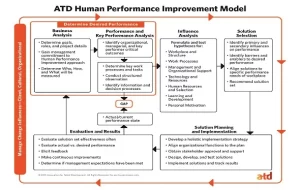
ATD HPI Model, 2015
It includes the following key tasks.
Task 1: Identify Performance Gaps
The process starts by comparing actual vs. desired performance and identifying the gap between the two. This involves using data, KPIs (Key Performance Indicators), or observation of employees to measure actual performance results and comparing that to the desired results that the organization seeks.
Task 2: Analyze Root Causes
The next task is to uncover the root causes of the performance gap. Root cause analysis goes beyond obvious symptoms to look at underlying causes. While symptoms of performance problems usually involve missed deadlines, poor quality or low output, common root causes include: unclear expectations, lack of tools, inadequate skills, cultural barriers, poor leadership, undefined processes, lack of information or training.
Root cause analysis may involve data collection, scientific research or expert opinion to uncover what is really preventing higher levels of performance. One simple technique is called Five Whys. When looking at a symptom of poor performance, ask why the symptom exists five times to dig deeper until the root cause surfaces. For example, if a manager is experiencing repeated missed deadlines, the five whys might go like this. One, why are deadlines being missed? Because employees don’t have enough time. Two, why don’t employees have enough time? Because they have multiple deadlines that interfere with each other. Three, why do employees have multiple interfering deadlines? Because management has not prioritized work to create realistic deadlines for high priority tasks. Fourth, why hasn’t management prioritized work to create realistic deadlines? Because senior management keeps changing organizational priorities and goals. Fifth, why does senior management change priorities so often? Because they don’t know how to respond to rapid changes in their key markets and are divided about the best way forward. And on and on.
In this example, we can conclude that employees missing deadlines is ultimately caused by poor senior management strategic planning, since they cannot figure out a consistent, long-term strategy to remain competitive in the marketplace. If management wants to address missed deadlines, focusing on individual employees instead of their own role would be addressing the symptom. Addressing the need for better strategic planning would be getting directly at the root cause of the problem.
Task 3: Select Solutions
Once managers determine the root cause, they can then consider the best options to address it. In some cases, the solution becomes obvious, given the root cause. For example, if employees don’t know how to use a new computer system and as a result, it is not being used as intended, then the obvious solution is training the employees. In other cases, several viable options may emerge, including blended solutions. These could include: process redesign, training, coaching, incentives, leadership or additional resources.
Task 4: Implement Solutions
Implementation is where the rubber meets the road. Managers should pilot test any new solution first to see how it works. It is important to involve stakeholders in the implementation and to have a change management plan to underpin the effort.
Once a solution has been proven to work, it should be institutionalized in policies and procedures and supported by job aids and work instructions. Employees should receive training on how to incorporate innovative solutions into their work.
Task 5: Evaluate & Adjust
The final task of HPI is to evaluate the impact of the solutions. Depending on the nature of the intervention, a number of approaches can work. One focus should be to collect continuous feedback from stakeholders. Their satisfaction with the solution is key to sustaining it. Another critical area to evaluate is the impact on the work and the organization. Use existing metrics or create new ones that enable managers to monitor real-time impacts on productivity, quality and financial success.
Key HPI Principles Every Manager Should Embrace
Beneath the HPI process and serving as its foundation are a series of principles about performance that form the bedrock of HPI. These include the following:
- Performance is system-driven, not just person-driven
Most widespread human performance issues stem from poor processes or environmental factors. Focusing only on individual knowledge and skills often misses the root causes of poor performance.
- Leadership sets the climate for workplace performance
It’s common for managers to place the blame for poor performance squarely on their employees. However, employees can’t consistently hit moving targets. Clear expectations are the foundation of high performance and that’s the manager’s responsibility. Moreover, effective feedback fuels improvement in performance by reinforcing the right behaviors and quickly correcting errors before they become habits. Managers should ensure their feedback is timely, specific, and actionable. - Work motivation is driven by purpose, autonomy, and rewards
Employees don’t only work for the money, although fair pay is a bedrock. They are also driven by the intrinsic benefits of work, including fulfilling important social functions, collaborating with others, achieving worthwhile results and getting recognized for their outstanding work. The personal fulfillment that superior performance provides is a key underpinning of work motivation. It simply feels good to know that one’s labor is making a difference. Managers should remember that praise is free and unlimited in supply. Few other things are.
Practical Strategies to Start Applying HPI
- To begin implementing HPI, managers should introduce the concepts in a psychologically safe space for employees to share concerns and the obstacles that prevent them from being more productive.
- This should lead to conducting performance gap analyses on the highest priority tasks with your team. Identify current levels of performance and document the barriers that employees face. Ideate and define the desired level of performance that you are aiming for, keeping in mind the constraints that may exist.
- Brainstorm and develop solutions that have the highest potential for success. Start with small pilots first, to test novel solutions. Once something is proven to work, fully implement it by providing Standard Operating Procedures (SOPs) and job aids to remove ambiguity and create consistency. Offer multiple ways for employees to learn new processes and skills, including formal instructor-led training, e-learning and coaching.
- Use key performance indicators (KPIs) and performance dashboards for tracking and visibility. Monitor trends to spot additional areas for improvement. Publicize success and learn from failure.
Conclusion
Human Performance Improvement is about a systems approach to work performance, using a scientific problem-solving model to identify root causes and provide comprehensive solutions to performance issues. Managers who consistently apply HPI improve not only organizational results but also employee engagement and retention.